



ORGANS OF PARIS © 2026 Vincent Hildebrandt HOME ALL ORGANS
Neuilly-sur-Seine
Saint-Jean-Baptiste
158 Avenue Charles de Gaulle, 92200 Neuilly-sur-SeineOrgue de tribune OdC >



Saint Jean Baptiste was built in 1831 in a neoclassical
style. It suffered serious damage during the 1870 war
and then again during the Commune uprising in
1871.
From 1911 to 1918, the church was renovated under
the leadership of Abbé Salomon, gaining a chapel,
meeting rooms, and a presbytery.
Architecturally quite simple, this monument follows a
basilical plan. The entrance features a pediment
topped with a cross and adorned with a Lepaute
clock from the Bagatelle estate. Inside, several 17th-
and 18th-century paintings are listed as historic
monuments.
The main altar is crowned by a striking Crucifixion
and flanked by two early-18th-century gilded wooden
angel statues.
C3
The Great Organ was built in 1873 by Eugène et John Abbey
in an older case. In 1904, Charles Mutin did some
maintenance works and modified the organ slightly.
Between 1937-38 the house Pleyel replaced the
transmissions.
In 1971, the organ was reconstructed by Jean Bourgarel,
who ireplaced some romantic stops with mutations; the
rees of the Récit were removed as were all the mechnaical
parts and manuals. A électropneumatic system was
installed with a new console.
En 1983, Jacques Barberis did some maintenance works.
In 1992, Jean-Pierre Swiderski partly electrified this
instrument.
In 2023, the German organ builder Gerhard Grenzing has
been selected to carry out the restoration and enlargement
of the Abbey organ. Grenzing proceeded to the complete
dismantling of the instrument in June 2023 and transport
the instrument to his workshops.
The main lines of the project:
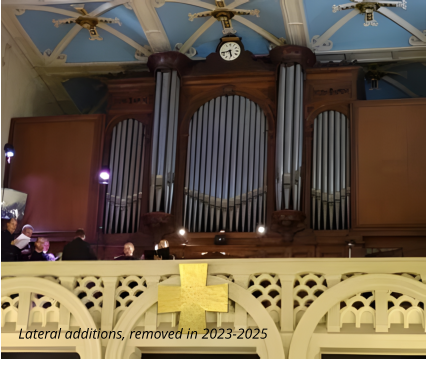
(1) To preserve, restore and enhance the buffet with the
removal of lateral additions.
(2) To restore the keyboards of "Grand-orgue" and "Récit
expressif" by the Abbey brothers.
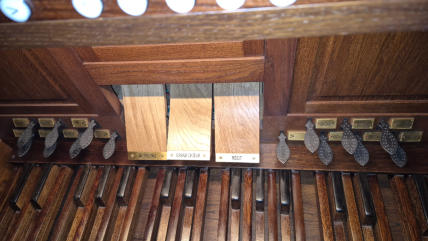
(3) To extend the Pedal to 32 notes.
(4) To add a new sound plan "Grand-chorus expressive" on a
new windchest, placed on the rear upper tribune with its
wind power supply complement.
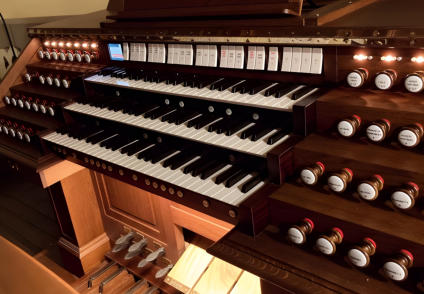
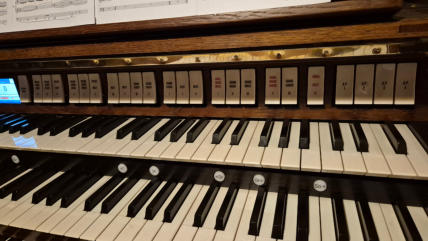
(5) Install a new electric transmission, a new console with
three keyboards and pedalboard with a computer.
The essence of the project of this restoration was to
preserve the organ in a layout that has certainly evolved
compared to the primitive organ (the Abbey-Mutin state of
1904), but which remains coherent by increasing it with an
additional manual to enrich the sound palette in the same
spirit. The mechanical transmission of 1904 that was not
returned gave way to an electronically managed
transmission. All the vital organs of the organ are preserved
and restored (framework, case, tank, windchests, expressive
box). The complements only concern the added sound
plane. A new three-manual console with pedal was built. A
state-of-the-art combinator completes this set. Visually, the
side additions to the sideboard are removed due to their
poor quality and inelegance. The organcase is thus much
better showcased. The sound plan of Pédale, which has
remained almost unchanged since the beginning of the
twentieth century, remains in this state except for its range,
which is extended to 32 notes, in order to meet the
requirements of the great organ repertoire. The sound plan
of the Grand-orgue keyboard returns to its 1904 stoplist
with the exception of the 16' reed stop which is replaced (as
in the Bourgarel state) by a Cornet stop with V ranks
allowing to maintain a certain aesthetic openness without
distorting the instrument since the 16' reed not restored in
this location is present in the Grand-chœur. The Récit
retains its 8-stop windchest to return to its particular Abbey
stoplist: Wooden Bourdon, Narrow Gamba, without 8'
Flute... The absence of this last stop is not detrimental since
it is planned for the Grand-chœur. The Grand-chœur is an
added keyboard of French aesthetic. Its pipes are placed on
the upper gallery, hidden behind the case. Its stops
complement the existing manuals in a resolutely symphonic
perspective by allowing, among other things, the following
uses: a large rich and diversified organ base, the possibility
of constituting a second plein-jeu, in response to that of the
Grand-orgue; a 16' bassoon as a soloist also allows a
complement to all the reeds; an 8' solo clarinet. This Grand-
chœur is enriched by a windchest independent of mutations
placed in its own expressive box, with the aim of using the
resulting 16' mutations to flesh out the Pedal. The colours
offered by the multiple mutations also make it possible to
do justice to the music of the twentieth and twenty-first
centuries (the presence, among other things, of an Eleventh
stop whose specific tuning allows the coveted quarter-tones
to be heard in some contemporary music).
Read more (in French)


Restoration works 2023-2025
Restoration consisting of restoring the instrument to
its almost primitive Abbey Mutin state of 1904 and
increasing it with an additional keyboard to enrich the
sound palette in the same spirit. The mechanical
transmission of 1904 that was not returned gave way
to an electronically managed transmission. All the vital
parts of the organ are preserved and restored
(framework, case, tank, windchests, expressive box).
The additions only concern the added sound plane. A
new three-manual console was built and equipped
with a computer.
The work was carried out by the Grenzing organ
factory with the participation of Denis Lacorre.
•
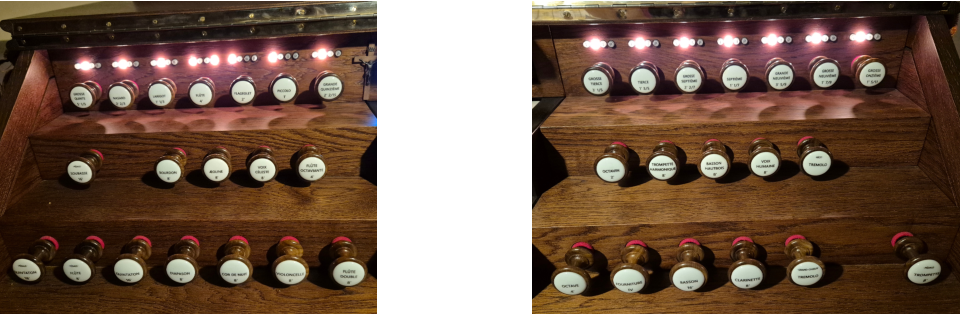
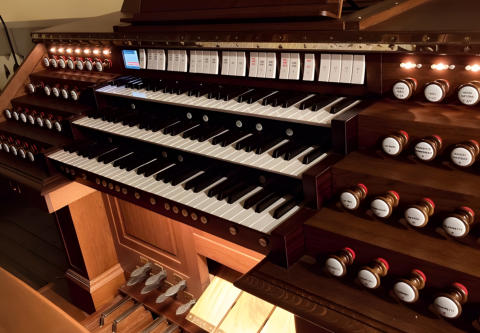
2024 Grenzing console in nineteenth century style
(in oak) with three manuals and a pedalboard.
Three expressive boxes.
•
Original wooden windchests preserved and
restored in 2024. New windchest (2024) for the
Grand-Chœur and the Mutations.
•
Restoration of the wind tunnel and installation of a
new engine in 2024.
•
Original Abbey pipework (Grand-orgue, Récit and
Pedal) restored and refurbished in 2023-2025.
Cornet of Jean Bourgarel's Grand-orgue restored
and revoiced. New pipework by Gerhard Grenzing
for the sound plan of the Grand-chœur and
Mutations.
•
Voicing of the instrument by André Lacroix and
Denis Lacorre in 2024-2025.
Stoplist 2024
Read more (in French)

1873 - Eugène et John Abbey (1)
1904 - Charles Mutin (6)
1938 - Ignace Pleyel (6)
1971 - Jean Bourgarel (3a)
1983 - Jacques Barberis (6)
1992 - Jean-Pierre Swiderski (3b)
2023-2025 - Gerhard Grenzing et Denis Lacorre (3)
III/38 (47) - Electronic transmissions
Stoplist
Titular organist
Olivier d'Ormesson
Parish website
Video
Olivier d'Ormesson
Photos
Buffet : Dominique Lust (facebook)
Console : Vincent Hildebrandt


Organs of Paris


Neuilly-sur-Seine
Saint-Jean-Baptiste
158 Avenue Charles de Gaulle, 92200 Neuilly-sur-SeineOrgue de tribune OdC >
ORGANS OF PARIS © 2026 Vincent Hildebrandt
Restoration works 2023-2025
Restoration consisting of restoring the instrument to its almost
primitive Abbey Mutin state of 1904 and increasing it with an
additional keyboard to enrich the sound palette in the same
spirit. The mechanical transmission of 1904 that was not
returned gave way to an electronically managed transmission.
All the vital parts of the organ are preserved and restored
(framework, case, tank, windchests, expressive box). The
additions only concern the added sound plane. A new three-
manual console was built and equipped with a computer.
The work was carried out by the Grenzing organ factory with
the participation of Denis Lacorre.
•
2024 Grenzing console in nineteenth century style (in oak)
with three manuals and a pedalboard. Three expressive
boxes.
•
Original wooden windchests preserved and restored in
2024. New windchest (2024) for the Grand-Chœur and the
Mutations.
•
Restoration of the wind tunnel and installation of a new
engine in 2024.
•
Original Abbey pipework (Grand-orgue, Récit and Pedal)
restored and refurbished in 2023-2025. Cornet of Jean
Bourgarel's Grand-orgue restored and revoiced. New
pipework by Gerhard Grenzing for the sound plan of the
Grand-chœur and Mutations.
•
Voicing of the instrument by André Lacroix and Denis
Lacorre in 2024-2025.
Stoplist 2024
Read more (in French)
1873 - Eugène et John Abbey (1)
1904 - Charles Mutin (6)
1938 - Ignace Pleyel (6)
1971 - Jean Bourgarel (3a)
1983 - Jacques Barberis (6)
1992 - Jean-Pierre Swiderski (3b)
2023-2025 - Gerhard Grenzing et Denis Lacorre (3)
III/38 (47) - Electronic transmissions
Stoplist
Titular organist
Olivier d'Ormesson
Parish website
Video
Olivier d'Ormesson
Photos
Buffet : Dominique Lust (facebook)
Console : Vincent Hildebrandt
C3
The Great Organ was built in 1873 by Eugène et John Abbey
in an older case. In 1904, Charles Mutin did some
maintenance works and modified the organ slightly. Between
1937-38 the house Pleyel replaced the transmissions.
In 1971, the organ was reconstructed by Jean Bourgarel, who
ireplaced some romantic stops with mutations; the rees of
the Récit were removed as were all the mechnaical parts and
manuals. A électropneumatic system was installed with a new
console.
En 1983, Jacques Barberis did some maintenance works.
In 1992, Jean-Pierre Swiderski partly electrified this
instrument.
In 2023, the German organ builder Gerhard Grenzing has
been selected to carry out the restoration and enlargement
of the Abbey organ. Grenzing proceeded to the complete
dismantling of the instrument in June 2023 and transport the
instrument to his workshops.
The main lines of the project:
(1) To preserve, restore and enhance the buffet with the
removal of lateral additions.
(2) To restore the keyboards of "Grand-orgue" and "Récit
expressif" by the Abbey brothers.
(3) To extend the Pedal to 32 notes.
(4) To add a new sound plan "Grand-chorus expressive" on a
new windchest, placed on the rear upper tribune with its
wind power supply complement.
(5) Install a new electric transmission, a new console with
three keyboards and pedalboard with a computer.
The essence of the project of this restoration was to preserve
the organ in a layout that has certainly evolved compared to
the primitive organ (the Abbey-Mutin state of 1904), but
which remains coherent by increasing it with an additional
manual to enrich the sound palette in the same spirit. The
mechanical transmission of 1904 that was not returned gave
way to an electronically managed transmission. All the vital
organs of the organ are preserved and restored (framework,
case, tank, windchests, expressive box). The complements
only concern the added sound plane. A new three-manual
console with pedal was built. A state-of-the-art combinator
completes this set. Visually, the side additions to the
sideboard are removed due to their poor quality and
inelegance. The organcase is thus much better showcased.
The sound plan of Pédale, which has remained almost
unchanged since the beginning of the twentieth century,
remains in this state except for its range, which is extended to
32 notes, in order to meet the requirements of the great
organ repertoire. The sound plan of the Grand-orgue
keyboard returns to its 1904 stoplist with the exception of the
16' reed stop which is replaced (as in the Bourgarel state) by a
Cornet stop with V ranks allowing to maintain a certain
aesthetic openness without distorting the instrument since
the 16' reed not restored in this location is present in the
Grand-chœur. The Récit retains its 8-stop windchest to return
to its particular Abbey stoplist: Wooden Bourdon, Narrow
Gamba, without 8' Flute... The absence of this last stop is not
detrimental since it is planned for the Grand-chœur. The
Grand-chœur is an added keyboard of French aesthetic. Its
pipes are placed on the upper gallery, hidden behind the
case. Its stops complement the existing manuals in a
resolutely symphonic perspective by allowing, among other
things, the following uses: a large rich and diversified organ
base, the possibility of constituting a second plein-jeu, in
response to that of the Grand-orgue; a 16' bassoon as a
soloist also allows a complement to all the reeds; an 8' solo
clarinet. This Grand-chœur is enriched by a windchest
independent of mutations placed in its own expressive box,
with the aim of using the resulting 16' mutations to flesh out
the Pedal. The colours offered by the multiple mutations also
make it possible to do justice to the music of the twentieth
and twenty-first centuries (the presence, among other things,
of an Eleventh stop whose specific tuning allows the coveted
quarter-tones to be heard in some contemporary music).
Read more (in French)

