


ORGANS OF PARIS © 2026 Vincent Hildebrandt HOME ALL ORGANS




C1
The church of Saint-Pierre-Saint-Paul houses the oldest
organ in Ivry-sur-Seine. After a gallery was built above the
main entrance in 1861, a public subscription was
launched the following year to acquire an organ and
proved very successful. The organ builder Stoltz was then
consulted. The well-known harmonium builder Alexandre
Père et Fils, whose factories were located in Ivry, heard
about the project and approached the parish council with
a rather surprising proposal to build an organ. The
council wisely chose Stoltz instead, understanding that
such a project was not Alexandre’s area of expertise.
An order was placed for a two-manual organ with pedal,
featuring a main oak case and a “dummy” Positive case,
for a cost of 1,600 francs. The organ originally included
two free-reed stops: a 16’ Cor anglais on the Récit and a
16’ Euphone on the Pedal—perhaps an idea inspired by
Alexandre’s proposal. The organ was inaugurated on 4
June 1863 by César Franck.
At the very beginning of the 20th century, the organ
began to show signs of wear. In 1901, Charles Mutin was
called in to overhaul and enlarge the instrument. The
expressive Récit was extended to 54 notes and the
specification was modified. The two free-reed stops were
replaced by a harmonic trumpet on the Récit and a 16’
bassoon on the Pedal. The work cost 7,500 francs, and on
20 December 1901 the instrument was back in service to
everyone’s satisfaction. Later, the pedalboard was
extended to 30 notes, with extensions of the Great and
Récit couplers, but without extending its two
independent stops, which remained limited to 18 notes.
At an unknown date, the pedalboard was extended from
18 to 30 notes. However, the pedal windchest remained
at 18 notes; the pedalboard was therefore used only with
couplers from F-sharp 2 to F 3.
The instrument underwent no significant alterations or
restoration until the 1980s, by which time it had become
almost unplayable. It was then entrusted to the Beuchet-
Debierre firm, which carried out a complete overhaul
without altering its fine tonal character.
In 2017, thanks to financial support from the municipality
of Ivry, the owner of the instrument, a further complete
overhaul was carried out. On that occasion, the two
independent pedal stops were extended from 18 to 30
notes, restoring the full tonal palette of this organ with its
fine neo-Gothic case.
Text and organ Photos (with thanks): Thierry Correard


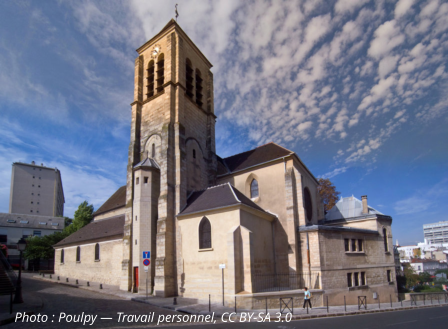
The present church, dedicated to St. Peter and St.
Paul, is mentioned for the first time in a text of 1158.
The lower part of the bell tower dates from this
period.
The 13th century saw the construction of two vaults
whose capitals and Gothic arches are still preserved.
In 1535, the staircase of honour, the entrance porch,
the corresponding vault and then the right spans of
the entrance were completed (one of the pillars
bears the date of 1575). On the same date, the
wooden vault of the central nave was completed. The
vault (behind the choir and chapel of the Sacred
Heart) was built in 1628 and in 1647 the stately
chapel, now the Chapel of the Virgin, was built. The
sacristy was built at the back of the North Chapel
between 1855 and 1859.
Source


1863 - Jean-Baptiste Stoltz (1)
1901 - Charles Mutin (2)
1982 - Joseph Beuchet (5)
2017 - Quentin Requier (5)
II/19 - mechanical traction
composition


Organs of Paris


ORGANS OF PARIS © 2026 Vincent Hildebrandt

C1
The church of Saint-Pierre-Saint-Paul houses the oldest organ
in Ivry-sur-Seine. After a gallery was built above the main
entrance in 1861, a public subscription was launched the
following year to acquire an organ and proved very successful.
The organ builder Stoltz was then consulted. The well-known
harmonium builder Alexandre Père et Fils, whose factories
were located in Ivry, heard about the project and approached
the parish council with a rather surprising proposal to build an
organ. The council wisely chose Stoltz instead, understanding
that such a project was not Alexandre’s area of expertise.
An order was placed for a two-manual organ with pedal,
featuring a main oak case and a “dummy” Positive case, for a
cost of 1,600 francs. The organ originally included two free-
reed stops: a 16’ Cor anglais on the Récit and a 16’ Euphone
on the Pedal—perhaps an idea inspired by Alexandre’s
proposal. The organ was inaugurated on 4 June 1863 by César
Franck.
At the very beginning of the 20th century, the organ began to
show signs of wear. In 1901, Charles Mutin was called in to
overhaul and enlarge the instrument. The expressive Récit
was extended to 54 notes and the specification was modified.
The two free-reed stops were replaced by a harmonic trumpet
on the Récit and a 16’ bassoon on the Pedal. The work cost
7,500 francs, and on 20 December 1901 the instrument was
back in service to everyone’s satisfaction. Later, the
pedalboard was extended to 30 notes, with extensions of the
Great and Récit couplers, but without extending its two
independent stops, which remained limited to 18 notes.
At an unknown date, the pedalboard was extended from 18 to
30 notes. However, the pedal windchest remained at 18 notes;
the pedalboard was therefore used only with couplers from F-
sharp 2 to F 3.
The instrument underwent no significant alterations or
restoration until the 1980s, by which time it had become
almost unplayable. It was then entrusted to the Beuchet-
Debierre firm, which carried out a complete overhaul without
altering its fine tonal character.
In 2017, thanks to financial support from the municipality of
Ivry, the owner of the instrument, a further complete overhaul
was carried out. On that occasion, the two independent pedal
stops were extended from 18 to 30 notes, restoring the full
tonal palette of this organ with its fine neo-Gothic case.
Text and organ Photos (with thanks): Thierry Correard

1863 - Jean-Baptiste Stoltz (1)
1901 - Charles Mutin (2)
1982 - Joseph Beuchet (5)
2017 - Quentin Requier (5)
II/19 - mechanical traction
composition