


ORGANS OF PARIS © 2026 Vincent Hildebrandt HOME ALL ORGANS





In the mid-19th century, Emperor Napoleon III
disliked the heavy stone pavilion that architect Victor
Baltard had designed for the first Parisian market
halls (Les Halles), which Parisians had already
nicknamed “Le Fort des Halles.” Baltard then
imagined new buildings, using iron, cast iron, and
glass, in a resolutely innovative spirit. The modern
and bold project enthused the Emperor, and the
Parisian market halls would go on to win widespread
admiration. According to Gustave Eiffel, Baltard
opened Paris to the 20th century; Verlaine spoke of
“the lacework of Vulcan”… This architecture, which
quickly became famous, was copied many times.
This complex of ten pavilions housed, among others,
greengrocers, fishmongers, and butchers. It was built
between 1852 and 1870 by the architect, who died in
1874, four years after the tenth pavilion had been
erected.
But in 1972, the Parisian market had to expand and
left these pavilions, which the authorities decided to
demolish, sparking fierce protests. As a result,
Pavilion No. 8, which had housed the egg and poultry
market, was preserved to safeguard a unique
example of early metal architecture.
Nogent-sur-Marne, just outside the capital, was
chosen for its relocation. On 6 January 1976, the first
cast-iron column of the Pavillon Baltard was erected
on the Beauté site, where the castle of Charles V had
once stood. It was listed as a Monument Historique
in 1982.
Today, the Pavillon Baltard has become an essential
venue for events in the Paris region.
Source
1931 - Hill, Norman and Beard/Christie
1970 - Jacques Probst
1980 - Danion-Gonzalez
1980-2005 - Bernard Dargassies
IV/130 (15) - electrical traction
composition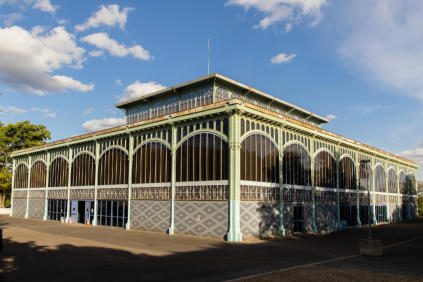
Videos | Eric Cordé
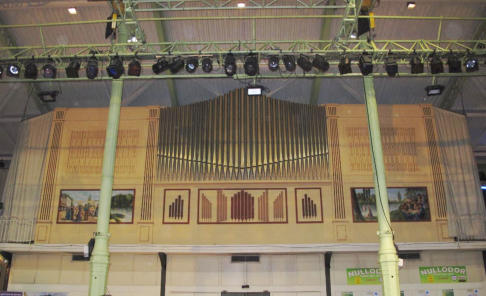
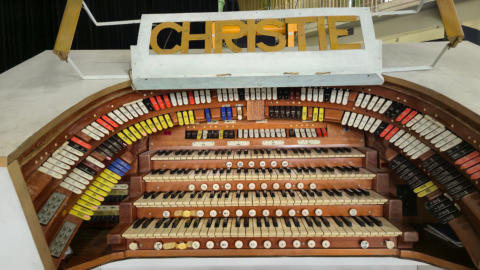
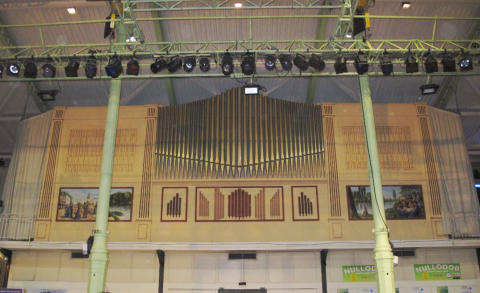
The famous Christie organ, now installed in the Pavillon
Baltard, was originally built for the Parisian cinema
Gaumont-Palace (Place Clichy). In 1900, this building was a
hippodrome hosting circus shows and large historical
reenactments. It only truly became a cinema when Léon
Gaumont bought it in 1910. He adapted the venue and
enlarged it in 1930 into a 6,000-seat Art Deco theatre, making
it the largest cinema in the world at the time.
The Christie organ was installed in 1931. It was built by the
Hill, Norman & Beard workshops in London (their theatre-
organ division was branded “Christie”, after the factory
owner John Christie).
Around 1969–1970, the organ was cleaned and slightly
modified by organist Jacques Probst, under the supervision
of organist Gilbert Le Roy, to bring its tonal character closer
to that of Wurlitzer theatre organs (enlarging the Tibia by
shifting ranks, adjusting tremolo speeds, and modifying the
attack of the percussion stops).
In 1971, the closure of the Gaumont-Palace was announced;
it took effect in 1972. The cinema hall was demolished, and
the organ might have suffered the same fate if Alain Villain
had not intervened. As head of the STIL music publishing
house and a filmmaker, Villain had fallen in love with the
Gaumont-Palace organ and could not imagine its
disappearance. Before the demolition, he recorded a disc
and a short film there, with Tommy Desserre at the console.
He then stored the instrument in the film archives at Bois-
d’Arcy, hoping to give it a new life. Faced with complete
indifference from both the organ world and the film world,
Villain finally decided to sell the organ at auction in 1976 at
Drouot Rive Gauche. In a last-minute rush, on the morning of
the sale, the instrument was provisionally listed as a
*Monument Historique* to prevent it from leaving France. It
was officially listed in 1977.
The organ was bought by the City of Nogent-sur-Marne,
thanks to the efforts of the then mayor, Roland Nungesser.
Between 1978 and 1980, the organ was restored and
reinstalled (with numerous errors) in the Pavillon Baltard (the
only survivor of the Paris Halles, demolished in 1971) by the
Danion-Gonzalez firm. It was inaugurated in 1980 by Simone
Bernard and Gilbert Le Roy (former Gaumont-Palace
organists), with the participation of Pierre Cochereau.
Bernard Dargassies, who had taken part in the reinstallation
work, became the resident organist from 1985 onwards. He
led several campaigns of work and improvements to correct
the mistakes made during the 1980 reinstallation, as well as
those from 1970, bringing the instrument as close as
possible to its original state. To add more power and
precision of attack, Dargassies added a Post Horn reed stop;
he financed this work entirely himself.
From 2005 onwards, the instrument was neglected and then
completely abandoned, with no maintenance at all. This
period of silence lasted almost 15 years, during which access
to the organ was not possible. It was not until 2019 that the
instrument could be used and maintained again, albeit very
sporadically.
Although still playable, the instrument is now in an extremely
alarming condition and awaits a complete restoration.
Many thanks to Eric Cordé for the additional information.
More information
Video
L'orgue de cinéma Christie du Gaumont Palace au Pavillon
Baltard Bruno Lhuissier.
The instrument is signed Christie, the Theatre Organs
division of William Hill & Son – Norman & Beard Ltd.
(Norwich, Norfolk), two traditional and renowned
English builders that had merged in 1916.
It was altered relatively little during its short
existence (a revoicing was necessary, as it was
undersized for the large hall). Bernard Dargassies
added one rank (a Post Horn, replacing the old
chamade), but the original electro-mechanical
system was lost due to lack of space in the Pavillon,
and replaced by an electronic combination system
and Solid State action.
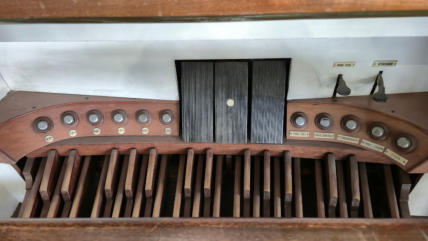
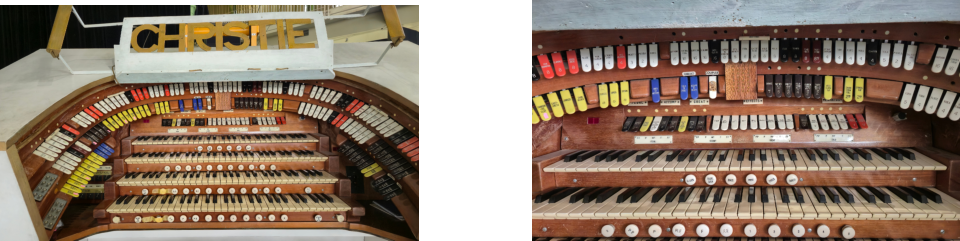
Typical of theatre and cinema organs, the unit organ
system multiplies the stops from a single set of
pipes: the original fourteen stops of the Gaumont-
Palace organ, with real bass and treble octaves
totaling 1,500 pipes, translate at the console into
some 140 stops across four manuals and pedal. This
instrumental world, then unknown here, had been
discovered by Tommy Desserre in New York as early
as 1928.
The traditional voicing of this style includes, among
the foundation stops, Diapason, Tibia, and Strings
(with the essential tremolo); among the reeds, Oboe,
Trumpet, Saxophone, Vox Humana, Trombone, and
Clarinet—a battery completed in 1991 by a Post Horn
donated by Bernard Dargassies.
Among the sound effects: siren, car and truck horns,
ship, police, and train whistles, sea sounds (with the
expressive boxes), fire bell, airplane, birds, telephone
ring, breaking crockery (this stop is said to be the
only one still in existence in the world)…
To these are added tonal percussion stops:
Glockenspiel, Marimba, Xylophone, Vibraphone,
Celesta; and non-tonal percussion: Bass drum,
Cymbal, Snare drum, Triangle, Woodblock,
Tambourine, Tom-tom (Tom-drum, stolen about ten
years ago), Castanets, Sleigh bells…
Source: Orgues Nouvelles/Michel Roubinet
Videos
Eric Cordé (upcoming)


Organs of Paris


ORGANS OF PARIS © 2026 Vincent Hildebrandt

The instrument is signed Christie, the Theatre Organs
division of William Hill & Son – Norman & Beard Ltd.
(Norwich, Norfolk), two traditional and renowned English
builders that had merged in 1916.
It was altered relatively little during its short existence (a
revoicing was necessary, as it was undersized for the large
hall). Bernard Dargassies added one rank (a Post Horn,
replacing the old chamade), but the original electro-
mechanical system was lost due to lack of space in the
Pavillon, and replaced by an electronic combination system
and Solid State action.
Typical of theatre and cinema organs, the unit organ system
multiplies the stops from a single set of pipes: the original
fourteen stops of the Gaumont-Palace organ, with real bass
and treble octaves totaling 1,500 pipes, translate at the
console into some 140 stops across four manuals and pedal.
This instrumental world, then unknown here, had been
discovered by Tommy Desserre in New York as early as 1928.
The traditional voicing of this style includes, among the
foundation stops, Diapason, Tibia, and Strings (with the
essential tremolo); among the reeds, Oboe, Trumpet,
Saxophone, Vox Humana, Trombone, and Clarinet—a battery
completed in 1991 by a Post Horn donated by Bernard
Dargassies.
Among the sound effects: siren, car and truck horns, ship,
police, and train whistles, sea sounds (with the expressive
boxes), fire bell, airplane, birds, telephone ring, breaking
crockery (this stop is said to be the only one still in existence
in the world)…
To these are added tonal percussion stops: Glockenspiel,
Marimba, Xylophone, Vibraphone, Celesta; and non-tonal
percussion: Bass drum, Cymbal, Snare drum, Triangle,
Woodblock, Tambourine, Tom-tom (Tom-drum, stolen about
ten years ago), Castanets, Sleigh bells…
Source: Orgues Nouvelles/Michel Roubinet
Videos
Eric Cordé (upcoming)
1931 - Hill, Norman and Beard/Christie
1970 - Jacques Probst
1980 - Danion-Gonzalez
1980-2005 - Bernard Dargassies
IV/130 (15) - electrical traction
composition
Videos | Eric Cordé
The famous Christie organ, now installed in the Pavillon
Baltard, was originally built for the Parisian cinema Gaumont-
Palace (Place Clichy). In 1900, this building was a hippodrome
hosting circus shows and large historical reenactments. It only
truly became a cinema when Léon Gaumont bought it in 1910.
He adapted the venue and enlarged it in 1930 into a 6,000-seat
Art Deco theatre, making it the largest cinema in the world at
the time.
The Christie organ was installed in 1931. It was built by the Hill,
Norman & Beard workshops in London (their theatre-organ
division was branded “Christie”, after the factory owner John
Christie).
Around 1969–1970, the organ was cleaned and slightly
modified by organist Jacques Probst, under the supervision of
organist Gilbert Le Roy, to bring its tonal character closer to
that of Wurlitzer theatre organs (enlarging the Tibia by shifting
ranks, adjusting tremolo speeds, and modifying the attack of
the percussion stops).
In 1971, the closure of the Gaumont-Palace was announced; it
took effect in 1972. The cinema hall was demolished, and the
organ might have suffered the same fate if Alain Villain had
not intervened. As head of the STIL music publishing house
and a filmmaker, Villain had fallen in love with the Gaumont-
Palace organ and could not imagine its disappearance. Before
the demolition, he recorded a disc and a short film there, with
Tommy Desserre at the console. He then stored the
instrument in the film archives at Bois-d’Arcy, hoping to give it
a new life. Faced with complete indifference from both the
organ world and the film world, Villain finally decided to sell
the organ at auction in 1976 at Drouot Rive Gauche. In a last-
minute rush, on the morning of the sale, the instrument was
provisionally listed as a *Monument Historique* to prevent it
from leaving France. It was officially listed in 1977.
The organ was bought by the City of Nogent-sur-Marne,
thanks to the efforts of the then mayor, Roland Nungesser.
Between 1978 and 1980, the organ was restored and
reinstalled (with numerous errors) in the Pavillon Baltard (the
only survivor of the Paris Halles, demolished in 1971) by the
Danion-Gonzalez firm. It was inaugurated in 1980 by Simone
Bernard and Gilbert Le Roy (former Gaumont-Palace
organists), with the participation of Pierre Cochereau.
Bernard Dargassies, who had taken part in the reinstallation
work, became the resident organist from 1985 onwards. He
led several campaigns of work and improvements to correct
the mistakes made during the 1980 reinstallation, as well as
those from 1970, bringing the instrument as close as possible
to its original state. To add more power and precision of
attack, Dargassies added a Post Horn reed stop; he financed
this work entirely himself.
From 2005 onwards, the instrument was neglected and then
completely abandoned, with no maintenance at all. This
period of silence lasted almost 15 years, during which access
to the organ was not possible. It was not until 2019 that the
instrument could be used and maintained again, albeit very
sporadically.
Although still playable, the instrument is now in an extremely
alarming condition and awaits a complete restoration.
Many thanks to Eric Cordé for the additional information.
More information
Video
L'orgue de cinéma Christie du Gaumont Palace au Pavillon
Baltard Bruno Lhuissier.